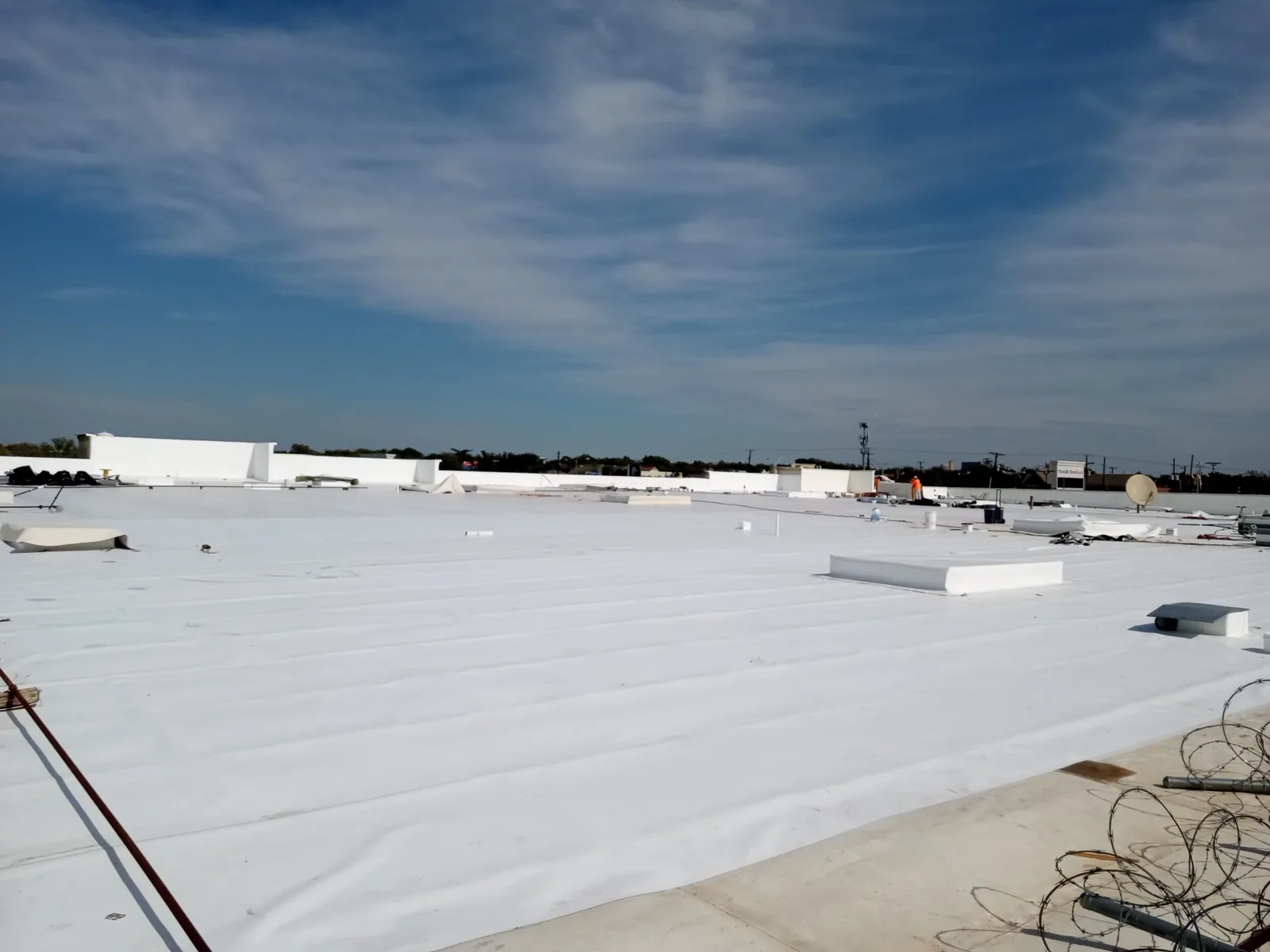
PVC Roofing in Thousand Oaks, CA
Roof Systems · Thousand Oaks, CA
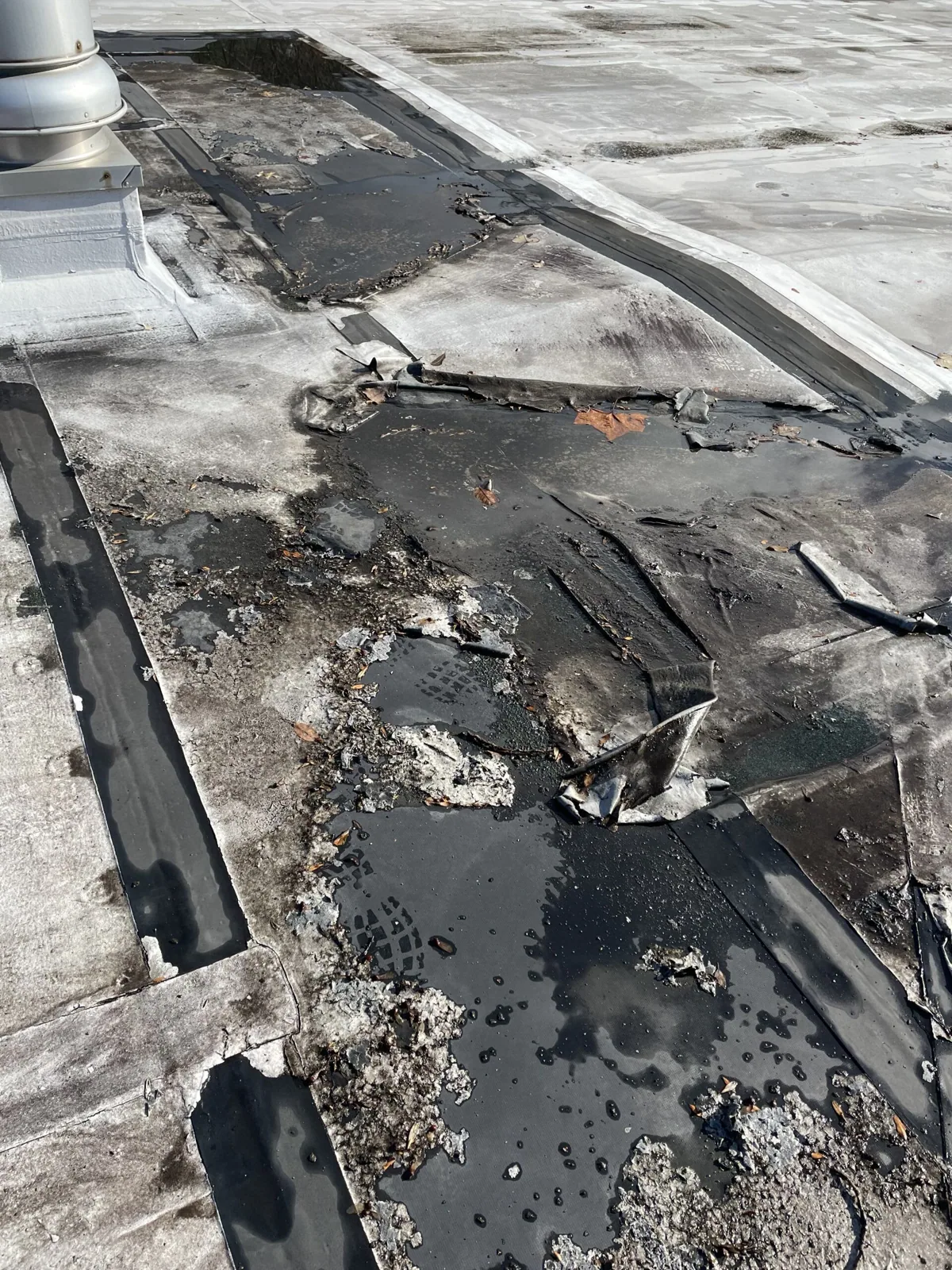
Grease film: a tacky, dark residue spread downwind of two kitchen exhaust fans, with the white PVC membrane underneath still flexible and every weld along the path still sealed. On a food-service or entertainment building, that finding shows why membrane compatibility with grease matters. The sheet shrugs off animal fats and oils that soften or swell other single-ply materials, and it keeps its seams intact on roofs where the surface is never really clean. For an owner in Thousand Oaks, CA, the practical question is not whether PVC is a good membrane. It is which of the buildings on the portfolio list actually have the exposure that justifies it, and which can be served by a less costly sheet.
PVC Roofing
Roof Systems
Call our team
Written findings and options
Thousand Oaks, CA
Ventura and Los Angeles counties
Chemistry: plasticizer, welds and what the sheet resists
Polyvinyl chloride is a rigid polymer made flexible by plasticizers, then reinforced with a polyester or fiberglass scrim and laminated with a UV-stable top layer. Hot-air welding fuses overlapping sheets into a single monolithic membrane, and a properly made weld is stronger than the sheet around it. The chlorine content gives the material natural resistance to flame spread, and the formulation tolerates grease, oils, many acids and the airborne residues that settle on roofs near industrial exhaust.
The same plasticizer that gives the sheet its flexibility is also its aging mechanism. Over many summers of Conejo Valley sun, some of it migrates out, the surface stiffens, and a roof that once draped easily over a cant strip begins to crack at stress points. A baseline survey records the flexibility of the sheet at the laps, the corners and the penetrations, and that reading is more useful for planning a replacement horizon than the age of the roof alone.
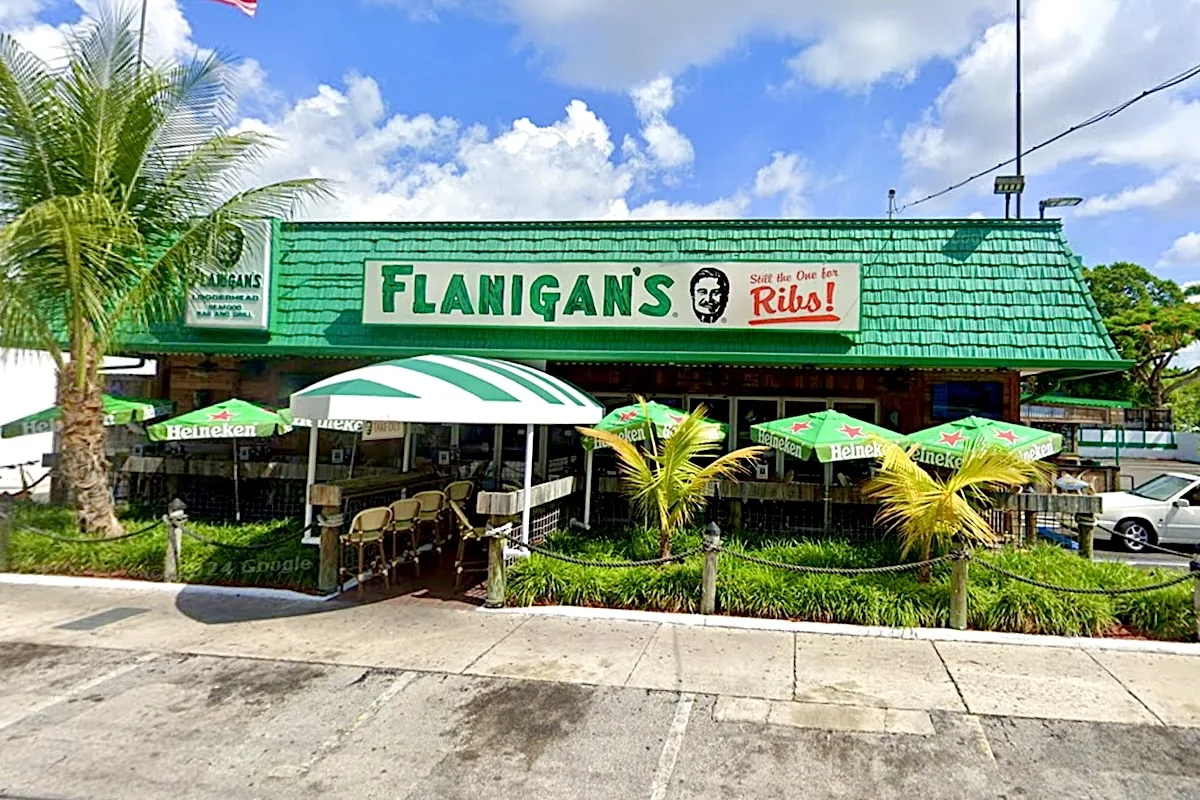
Exhaust: dine-in venues, kitchens and what lands on the membrane
Food-service roofs put exhaust fans above occupied and tenant areas, and each fan can discharge residue that settles downwind. A survey maps the exhaust path, membrane condition and service access before the owner decides whether a repair or different membrane is warranted. On a membrane that is not built for it, the film softens the surface and attracts dirt that traps heat. On PVC, it mostly stays a housekeeping issue, provided the grease is contained.
We look at the fan curbs, the grease pans and the drainage path from each unit, because a plugged pan sends the whole discharge onto the sheet. Where a restaurant tenant has added fans without a change to the roof, we map the new discharge zones and mark the membrane for extra protection or a welded walk pad. Restaurant roofing rewards pairing the right sheet with the right maintenance habit, since neither does the job alone.
Campus: hospitals, labs and the mechanical-heavy roof
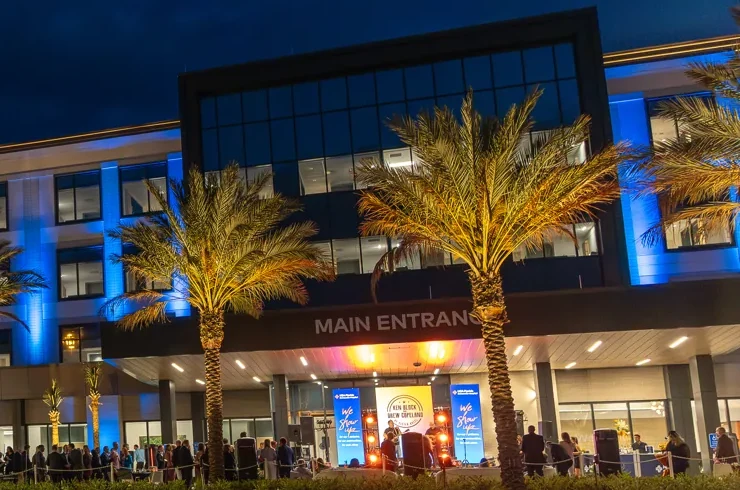
Los Robles Hospital and Medical Center in Thousand Oaks opened in 1968 as a 220-bed facility and has expanded since, so its roofs span several construction eras and carry rooftop mechanical for critical areas. A roof like that is a different problem from a quiet warehouse deck. Foot traffic is constant, equipment is dense, and any work near air intakes needs planning with facilities staff. PVC suits those conditions because hot-air welding makes no open flame, the seams tolerate repeated service visits, and the sheet resists the chemical residues that travel with medical and lab exhaust.
The Los Robles hospital district and similar clinical sites also need documentation that survives a change of facilities manager: photographs of each penetration, a map of weld test locations and a record of any seam that was repaired. The same habits carry into hospital roofing generally, including work windows that respect operating rooms and air handlers.
Ember exposure: Woolsey, Mountain and the assembly rating
The Woolsey Fire of November 2018 affected Agoura Hills, Oak Park and Westlake Village as well as Thousand Oaks and Newbury Park, with winds of 50 to 60 mph. The Mountain Fire of November 2024 burned 19,904 acres near Somis and Camarillo, with gusts forecast above 65 mph. Embers travel far ahead of a fire front, so the question for a roof is how it behaves when a glowing fragment lands on it. PVC resists flame spread, but the fire rating belongs to the entire assembly: membrane, insulation, cover board and attachment together.
We specify assemblies with a tested rating, and we pay attention to insulation and cover board choices because they change the rating. After a smoke or ember event, the same survey logic applies to fire damage: we look for char at laps, scorched edge metal, melted pipe boots and ash that has stained the surface and clogged drains.
Tradeoffs: first cost, alternatives and when PVC is the wrong sheet
PVC usually costs more at installation than TPO, and on a plain roof with few penetrations and no grease the extra spend may buy nothing the owner will ever use. In that case TPO serves, and we say so. Where plasticizer retention is the concern, as it is on roofs with chemical exposure or ponding, the KEE-modified PVC sheet adds a ketone ester that holds the plasticizer longer. Details matter as much as the field: pipe boots, corners and curb wraps are prefabricated and welded, and when one lets go the repair is a flashing failure job, not a membrane job.
The decision rests on exposure, and exposure is something a survey can measure. We walk each roof, mark every exhaust discharge, every chemical stain and every area where foot traffic wears the surface, then sort the portfolio by what each roof actually sees. A prioritized scope built that way sends the premium sheet only to the buildings whose findings call for it, and it gives the asset manager a defensible reason for each line in the reserve study.
On a property along the Thousand Oaks Boulevard corridor, a PVC survey maps weld condition, exhaust discharge and access points so each repair area can be prepared without disrupting adjacent tenants.
Before specifying PVC, confirm that the existing substrate, adhesive and cover board are compatible with the proposed assembly. Verify the membrane thickness, reinforcement, seam condition and attachment pattern, then test representative welds where the work specification calls for it. The exhaust map should show both the discharge direction and any residue that has reached the roof surface. If grease exposure is concentrated, detail the cleaning and inspection interval as part of the maintenance plan; changing membrane alone does not correct a discharge path. A repair should use compatible material and restore the welded seam without trapping contamination beneath the patch. These checks help owners compare PVC with other single-ply options based on the roof's actual chemical exposure and service needs rather than a generic product ranking.
Commercial Roofing Questions
Why do restaurant and dine-in roofs often go to PVC?
Kitchen exhaust throws animal fats and oils onto the membrane downwind of every fan, and some single-ply materials soften or swell under that load. PVC resists it, so the sheet stays pliable and the welds stay sealed. Grease pans still belong under every fan.
Is the PVC premium worth it on a medical building?
Often, where the roof carries dense equipment, lab or sterilization exhaust, or tight service windows. A quiet roof with few penetrations may be served well by TPO at lower first cost. We price both and compare the lifecycle.
Can a PVC roof be repaired by welding years after installation?
Weldability fades as the surface ages and collects dirt and plasticizer film. Old sheet needs cleaning and often a compatible patch material, and a test weld on the actual roof comes before any repair scope is committed.
How does a PVC roof behave if embers land on it?
The membrane resists flame spread, though the tested rating belongs to the full assembly. Ask for the assembly rating in writing, and expect us to inspect laps, boots and edge metal after any smoke event.
What happens before welding starts on a hospital roof?
Air intakes come first. We locate them with facilities staff, schedule work away from sensitive areas and confirm that hot-air welding produces no open flame or odor that reaches occupied floors.