Commercial Roof Replacement in Thousand Oaks, CA
Commercial Roofing Services · Thousand Oaks, CA
Finding: saturated insulation across the north third of the field, with the membrane seams still tight and the surface still intact. On a low-slope office or R&D building in the Conejo Valley, that is the pattern that turns a repair discussion into a replacement discussion, because the membrane can look serviceable from the parapet while the layer beneath it has stopped doing its job. A full tear-off is the correct answer when the deck or the insulation is compromised, when past repairs now outnumber the original details, or when the remaining service life no longer reaches the next budget cycle. We scope commercial roof replacement in Thousand Oaks, CA from that condition data rather than from a calendar age, and we write the findings down so the decision can be defended to ownership, lenders and tenants.
Commercial Roof Replacement
Commercial Roofing Services
Call our team
Written findings and options
Thousand Oaks, CA
Ventura and Los Angeles counties
Findings: what justifies a full tear-off
Replacement is a conclusion, not a starting position. The findings that support it are specific and can be photographed: insulation that holds moisture at more than isolated spots, deck that is corroded, delaminated or soft underfoot, seams that open under a probe across a wide area, flashings that have pulled away from walls and curbs because the membrane beneath them has shrunk, and a surface that has lost its reflective or protective layer to sustained UV degradation. Any one of these can be repaired. Several together, spread across the same roof, usually mean that each repair buys less time than the last.
We separate the roof into zones and grade each one, so the owner can see that the drain sump area is finished while the east field is merely tired. That grading is what lets a portfolio manager choose between a complete tear-off now and a phased program, and it is the same grading that a reserve study needs to carry an honest replacement horizon.
Scope: what the tear-off removes and what replaces it
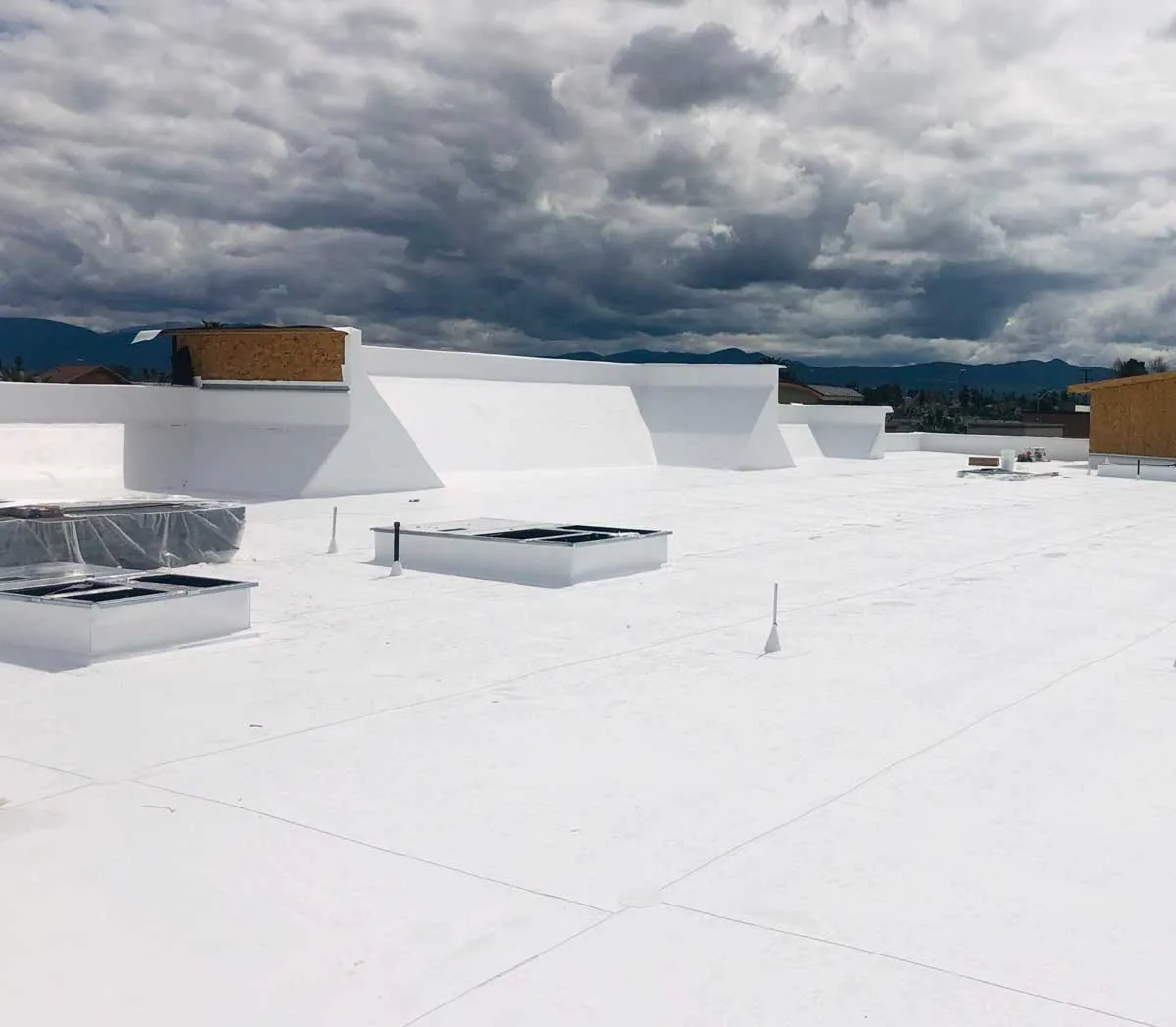
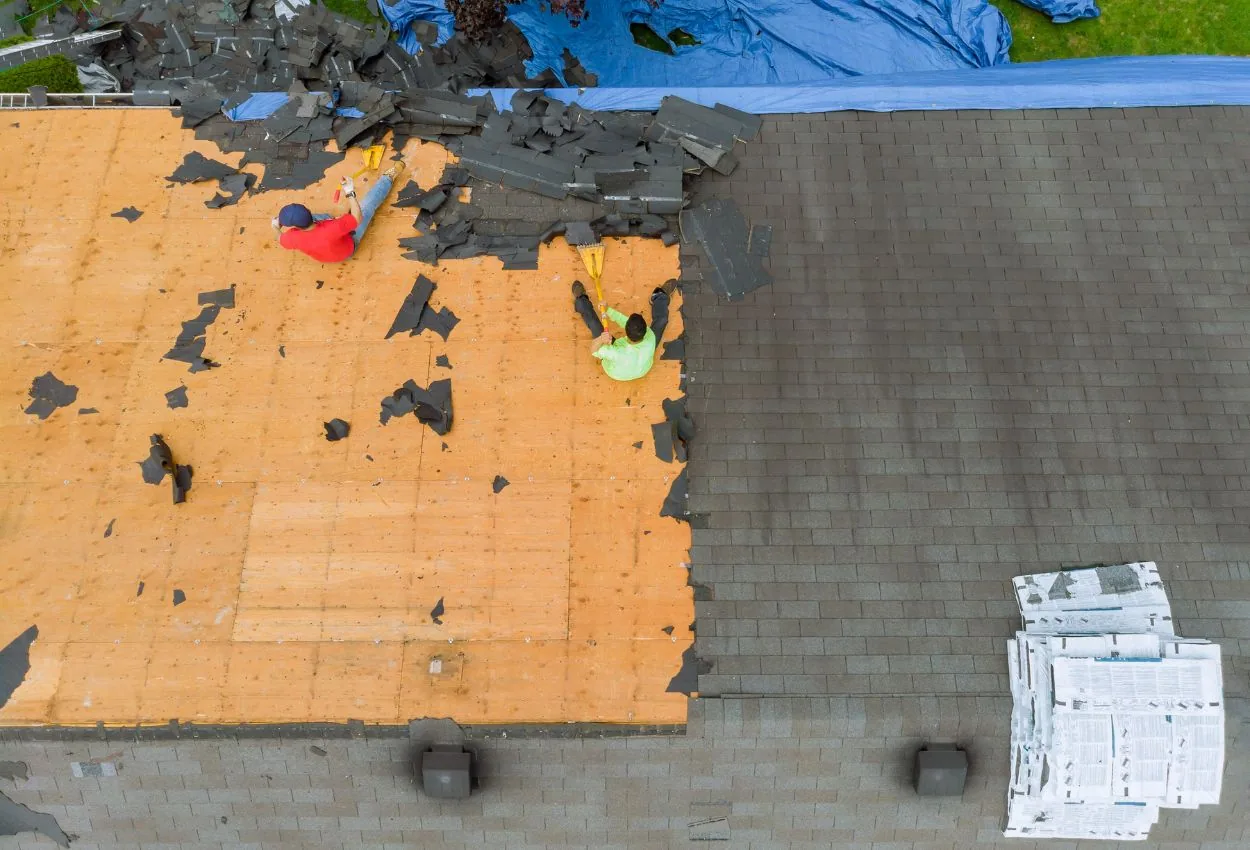
A replacement removes the membrane, the failed insulation and any flashing that cannot be reused, then exposes the deck for inspection before anything new goes down. Deck repair is the largest unknown on most jobs, which is why we state it as an allowance with a unit approach in the proposal and not as a hidden contingency. The new assembly is built in order: attachment to a sound deck, insulation sized to the energy code and tapered where water has been standing, a cover board where the system calls for one, the new membrane, and then the details, which decide whether the roof performs for its full life.
The membrane choice follows the building. A large flat warehouse roof often suits TPO roofing, while a roof with heavy foot traffic, grease exposure or many penetrations may suit another single-ply, a modified bitumen assembly or a metal retrofit. We lay out the options in writing with the tradeoffs on durability, repairability and cost drivers, and the owner picks.
Exposure: Santa Ana wind, ember and heat on a new assembly
Replacement is the one moment when a roof can be rebuilt for the exposure it actually faces. Santa Ana winds can exceed 40 mph in this part of Ventura County and have channeled through the passes to cause structural damage, so wind uplift at edges, corners, parapets and rooftop equipment is a design input, not an afterthought. Edge metal, termination bars, fastener density and adhesive coverage are specified for the perimeter zones where uplift concentrates, and curbs and equipment supports are flashed so that a gust cannot peel them.
The same winds carry embers. The Woolsey Fire in 2018 and the Mountain Fire in 2024 both moved under extreme offshore wind, and the Kenneth Fire in 2025 again brought evacuation warnings to the east edge of the Conejo Valley. A replacement is the time to confirm that the assembly carries the fire classification the local code expects, that penetrations and vents are detailed against ember entry, and that the roof can be cleaned of ash without damaging the surface. Summer heat adds a steady load, because hot days push membrane surface temperatures up while rooftop HVAC runs hardest, which is why reflective surfaces and ventilated equipment supports matter here.
Sequence: permits, phasing and tenant impact
The City of Thousand Oaks amended its Title 8 building regulations in 2025 to adopt and amend the 2025 California codes, including the energy, existing building and wildland-urban interface codes, and the California Building Code based on the 2024 International Building Code took effect on January 1, 2026. A reroof permit now sits inside that framework, and the energy code touches roofing and cool roof provisions on nonresidential work. We assemble the permit scope with those requirements in mind so that inspection does not become the surprise.
On an occupied campus, tenant impact is the other half of the schedule. We phase the tear-off in sections so that no more roof is open than can be dried in the same day, we stage material away from entrances and loading docks, and we plan noisy deck work and fastening around lab, clinic and office hours. Short winter storms are the reason dry-in discipline matters: Newbury Park gets about ten inches of rain a year, mostly in a short winter season, and an open section is the most exposed place on the building when a storm arrives. On a building that cannot be vacated, the tear-off runs on the terms of occupied building reroofing, with the occupants' limits fixed before the first section opens.
Documentation: the record that follows the building
When the work is done, the owner should hold more than a warranty envelope. We provide photographs of the deck condition, the insulation and cover board installed, the flashing details and the completed surface, along with a drawing of the roof showing drains, penetrations and repaired deck areas. That record becomes the baseline for every later commercial roof inspection, and it makes future leak tracing faster because the next technician knows what is under each section.
For owners who manage several buildings, the same documentation feeds roof capital planning, so the new roof enters the portfolio with a condition index, a maintenance interval and a realistic end-of-life estimate. Rancho Conejo Industrial Park held more than 120 properties as of 2017, and an owner with several buildings there can use one well-documented replacement as the pattern for the rest of its holdings.
Commercial Roofing Questions
How do I know a roof needs replacement and not another repair?
Wet insulation, a compromised deck, widespread seam failure or repairs that no longer hold all point toward replacement. A moisture survey and a few core samples turn that suspicion into a map. Where the findings are limited, a planned repair or a recover may be the better use of budget.
Can a new roof go over the old one instead of a tear-off?
Sometimes. Code limits the number of roof coverings, and a recover is not appropriate over wet insulation or a damaged deck. We confirm those conditions first, and when both check out, a recover over the existing roof can save the tear-off.
Will my tenants be able to stay in the building?
In most cases, yes. The work is phased so that only a controlled portion of the roof is open at a time, and we schedule loud deck work away from sensitive hours. A tenant impact plan is part of the proposal.
How long does a commercial reroof take?
Roof area, deck repair, access, weather windows and the system chosen all move the duration. We give a phased schedule with each section's dry-in date, and Santa Ana wind days are treated as likely stoppages for loose material.
What drives the cost of replacement?
The main drivers are roof area, the amount of deck repair, insulation thickness and tapered design, the membrane system, the number of penetrations and curbs, and access for equipment. We price each as its own line so the owner can compare scopes.