Shopping Center Roofing in Thousand Oaks, CA
Property Types We Roof · Thousand Oaks, CA
Tenant ledger, inline bay at the north end: three work orders for the same ceiling stain in eighteen months, each closed with a patch, and a lease clause that leaves the roof to the landlord. A ledger like that is a condition report of its own. It says that the roof section over one bay has been repaired as a symptom and never as a system, and that the real number belongs in a capital plan instead of in the maintenance line. Retail roofs are judged by the tenants beneath them, and a landlord with a dozen bays under one membrane hears about every defect. We survey shopping centers and strip retail in Thousand Oaks, CA section by section, tie each finding to the bay below it and give ownership a prioritized scope that stops the cycle of patches.
Shopping Center Roofing
Property Types We Roof
Call our team
Written findings and options
Thousand Oaks, CA
Ventura and Los Angeles counties
Phases: one center, roofs added in stages
City planning materials identify the Moorpark Road/Janss Marketplace subarea as commercial development with a mix of shopping and entertainment. That retail setting underscores why a roof survey has to track separate tenant zones instead of assigning one condition to an entire property. Roof sections can differ in system, insulation depth, drainage design, penetration count and age; the survey records what is present rather than inferring a uniform assembly from a shopping district. We map each section against its own evidence: membrane condition, seam probe results, parapet and canopy flashing, and moisture in the insulation. The report shows ownership which area needs the next reserve allocation. Core cuts and moisture mapping separate a recover candidate from a full replacement.
Ownership: what a sale does to a roof schedule
The Oaks is the largest shopping center in Ventura County, a two-level indoor and outdoor regional mall of 1.3 million square feet that opened in 1978 and listed about 170 stores as of 2018. Stockdale Capital Partners bought it from Macerich in late 2024, and a change of ownership of that kind often triggers capital repair work on its roofs, because a new owner wants a documented baseline before it commits to leasing or renovation. A property of that age and size is surveyed in zones, with the oldest and most exposed sections first, and each zone gets its own grade so that a repair budget can follow the evidence instead of the loudest complaint. The same logic applies to every transaction in the retail sector, and our due diligence roof surveys give real estate investors and lenders a remaining service life and a repair reserve before closing instead of after it. For a property with large tenant spaces, a vacancy or lease change is a useful point to compare the roof plan with the fit-out scope, identify added equipment and confirm that abandoned curbs are closed.
Leases: who owns the leak above a tenant bay
Many retail leases give the landlord the roof structure and the tenant the contents, and that division produces predictable arguments after a leak. A tenant reports damaged inventory, the landlord sends a roofer to patch the nearest defect, and nobody records where the water actually entered. Our written findings include a leak trace for each bay, which is rarely the same location as the stain on the ceiling tile: the entry point, the path through the assembly and the likely cause, whether it is a lifted seam at a rooftop unit curb, a split flashing at a parapet or ponding near a drain. That record supports the owner in common-area maintenance reconciliation and keeps repair spending attached to the correct section of roof. For a center with many small tenants, commercial roof leak repair works best when every call is logged against a roof plan.
Traffic: more than five million visitors a year and a narrow work window
The Oaks draws more than five million visitors a year, and a center with that volume treats the roof as something that must never be noticed. Staging stays out of the fire lanes and customer entrances, hoisting happens before opening or after closing, and pedestrian routes below the work are barricaded or covered. Deliveries are timed to the loading schedule, and loud tear-off is limited to hours when the shopping floor is quiet, and rooftop air intakes for restaurants and large tenants are located and protected before any adhesive is opened. A smaller strip center sets simpler constraints, but a center with a grocery store, a pharmacy or a restaurant still needs fumes kept away from food service, and a former big box being re-tenanted is a big-box retail roof job of its own. Seasonal peaks matter too, since a center is least tolerant of disruption in the weeks around the winter holidays, and work that can finish before then should. In every case the sequencing plan is part of the proposal, so that the tenant impact of each option is visible before the owner chooses.
Edges: canopies, parapets and signage in a Santa Ana event
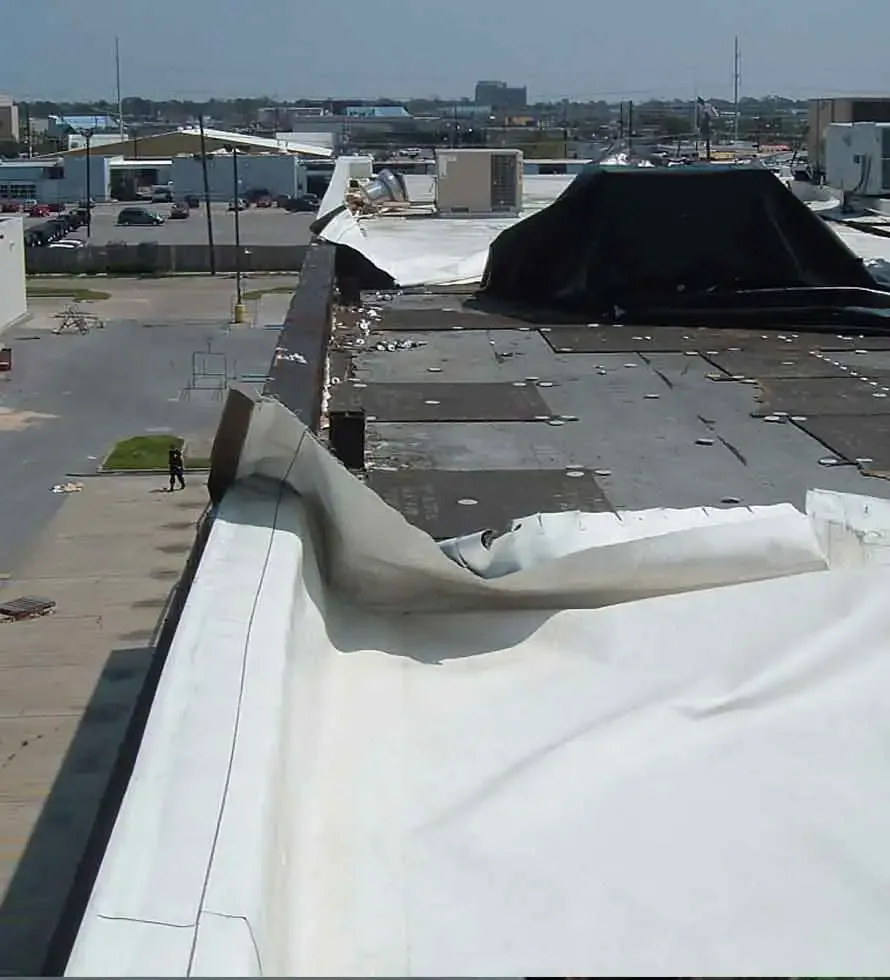
Retail buildings carry more perimeter than most commercial roofs: long parapets, storefront canopies, tower elements and sign structures that all create uplift when offshore wind crosses the valley. Santa Ana gusts that can exceed 40 mph channel through the passes and pull at coping, flashing and rooftop equipment, and the November 2024 Mountain Fire arrived with gusts forecast above 65 mph. We check every perimeter detail on a retail roof for fastener condition, sealant and lap integrity, and a roof that has already lifted once is a candidate for wind damage roof repair before the next event. A retail portfolio that runs from Thousand Oaks to Calabasas and Camarillo takes the same wind event at once, so it should be walked on one schedule, with the edge details of the most exposed centers first.
The condition plan should follow the way the property operates. We identify food-service exhaust, sign supports, canopy drains and rooftop access routes before setting a work zone, then sequence noisy or disruptive work away from the busiest tenant periods. The Oaks draws more than five million visitors a year, which makes pedestrian protection and clear service access part of the roof scope. Each proposal separates active leaks, preventive repairs and larger sections approaching replacement, so ownership can coordinate the roof budget with lease and tenant plans.
At an occupied commercial property in Camarillo Old Town, the phasing plan begins with tenant access, loading routes and a clear path to each active roof zone.
Commercial Roofing Questions
Should a landlord survey the roof before a center is re-tenanted?
Yes, before leases are signed. A new tenant often adds rooftop equipment, and a survey shows whether the roof can carry it and which sections should be repaired first.
How are repairs split when one membrane covers many tenants?
We log each repair against a roof plan and the bay below it. That record gives ownership a clean basis for allocating costs under the lease.
Can an open-air center be reroofed in phases?
Phases are usually the better route. Sections are closed each day, and the order follows tenant calendars, with holiday trading periods left clear.
What does a sale or refinancing require from the roof?
A written condition report with remaining service life and a repair reserve. Lenders and buyers read those numbers, so they should be supported by probes, moisture readings and photographs.
Do older centers need a different approach than outlet-style centers?
Older indoor centers tend to have more layered roofs and more penetrations, so core samples matter more. Outlet-style single-floor centers have long rooflines with many canopies, so the edge details need more attention.