Infrared and Core-Cut Moisture Surveys in Thousand Oaks, CA
Commercial Roofing Services · Thousand Oaks, CA
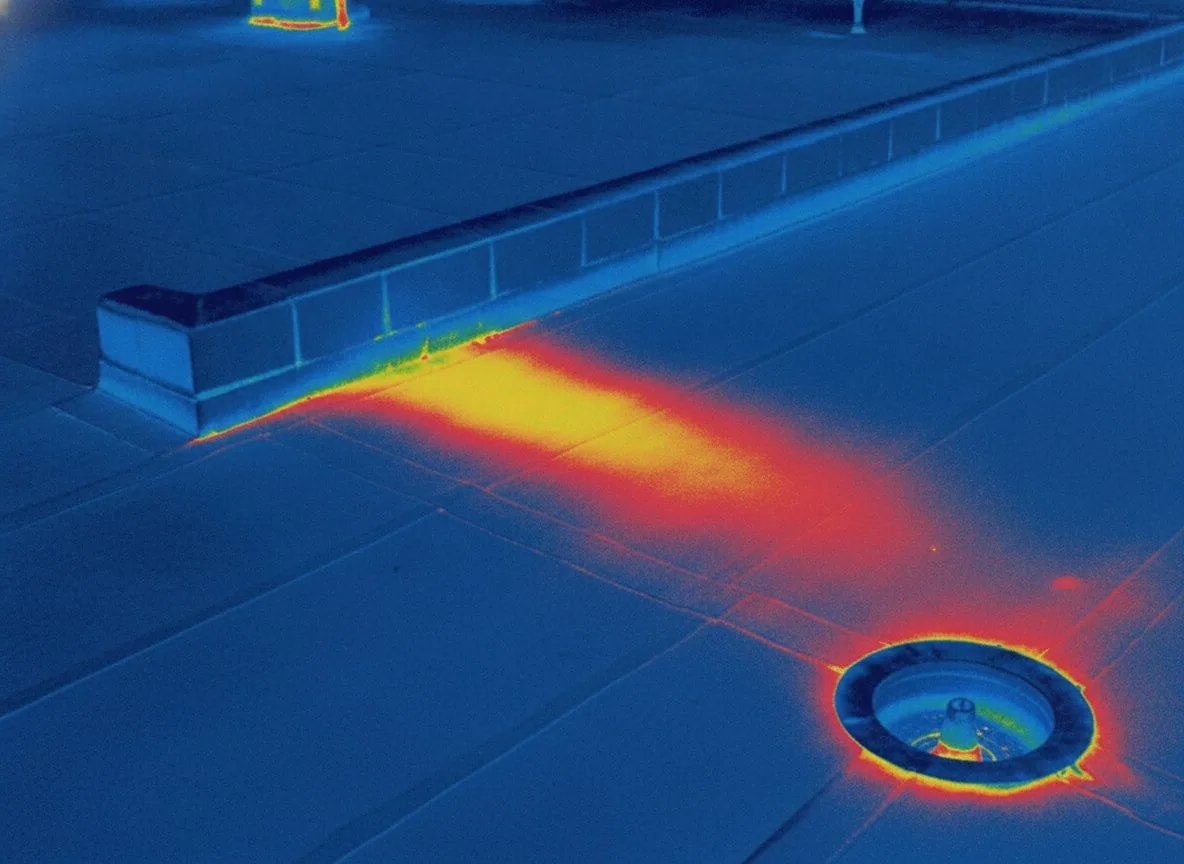
Thermal reading: warm, sharply bounded patches across the field of a roof that looked uniform at noon, appearing an hour after sunset. Wet insulation holds heat longer than dry insulation, and an infrared camera pointed at the roof as it cools shows that difference as a map. An infrared moisture survey is the most efficient way to find water trapped inside a low-slope assembly, where it does not stain a ceiling until it has been there a long time. For owners in Thousand Oaks, CA the survey answers a question that visual inspection cannot: how much of this roof is wet, where is it, and does the answer change the decision between repair, recover and replacement?
Infrared and Core-Cut Moisture Surveys
Commercial Roofing Services
Call our team
Written findings and options
Thousand Oaks, CA
Ventura and Los Angeles counties
Principle: why wet insulation shows up after sunset
During the day the sun heats the roof surface and the heat moves down into the assembly. Dry insulation resists that flow and releases little heat at night. Wet insulation has a higher thermal mass and stores more heat, so after sunset it radiates that heat for longer than the dry areas around it. As the roof cools, the wet areas read warmer on the camera, with an edge that usually follows the shape of the saturated boards or the path of the water.
The method works best on membranes that do not reflect heat away, such as dark or lightly colored surfaces over insulation, and it gives weaker readings on ballasted roofs, heavy gravel and some reflective coatings. We choose the approach to suit the roof: a walk-over survey with a handheld camera for most flat roofs, aerial thermal imaging to scan large roofs quickly, and moisture meters at the surface for a final check of each suspect area.
Conditions: choosing the right evening
Survey quality depends on weather, and the Conejo Valley supplies good days for most of the year. The roof must be dry, the day must have been clear enough to heat it, and the evening should be calm, since wind cools the surface unevenly and blurs the thermal contrast. Santa Ana wind days are poor survey days for that reason, even though they are dry. Heavy cloud has the opposite effect, because the roof never absorbs enough heat to reveal a difference.
Timing within the year matters too. Newbury Park averages about ten inches of rain a year, most of it in a short winter season, so a survey in late spring, after the rains have soaked any compromised areas and the sun has begun to dry the surface, often shows the clearest picture. A survey after a roof leak or storm event can also show whether moisture is limited to one location or has spread under the membrane. Scheduling that window is part of the work, and it is usually set after a first hands-on roof inspection shows where to look.
Confirmation: core cuts and meter readings
A thermal image is a prompt, not a conclusion. We mark every anomaly on the roof, then confirm with moisture meters and with core samples cut through the roof assembly at selected locations, including control points in areas that appear dry. Each core reveals the roof makeup in layers: the surface, the membrane or plies, the insulation, the cover board and the deck. It also shows whether the insulation is wet, damp or dry, and whether moisture is within a single layer or has traveled through the system.
The cores are patched at once with materials compatible with the roof, and each location is recorded on the plan. A confirmed core is also the evidence that matters in a later conversation with a building department, a manufacturer, an insurer or a buyer, since it turns an image into a physical sample. We take enough cores to support the conclusion but not so many that the survey itself becomes a source of new penetrations.
Mapping: from anomalies to a wet area you can measure
The deliverable is a scaled plan of the roof showing the confirmed wet areas, the dry areas, the suspect areas that could not be confirmed, the core locations and the type of roof found at each. We also report the approximate size of the wet area as a share of the whole, in plain terms that an owner can compare with the cost of replacing the insulation. Photographs of each core and of the thermal findings accompany the plan.
This map is a working document. A facilities manager can use it to see where leaks have been coming from, a roofer can use it to price removal and replacement of specific insulation, and an engineer can use it to judge whether a roof is a candidate for further work. When the survey follows an aerial scan, the plan combines both, which ties the thermal result to the imagery from a drone roof inspection.
Decisions: what the map changes
The survey changes the decision, sometimes more than once. If wet insulation is limited to a few small areas, those can be removed and replaced, and a planned commercial roof repair restores the roof at a modest cost. If the moisture is moderate and the rest of the roof is sound, the owner may be able to cut out and replace the wet sections and then recover the roof, because code permits recovering only over dry insulation. If the moisture is extensive, the roof has reached the end of its useful life, and the survey supports a full replacement with a defensible scope.
In every case the survey also protects the owner from spending in the wrong place. Repairing a roof with widespread wet insulation delays the problem and adds cost, while replacing a roof that is mostly dry wastes budget. The map shows which situation applies.
Applications: acquisition, claims and capital planning
Owners use the survey at three moments. At acquisition, it reveals hidden water in a roof that looks serviceable, and it puts a number on the near-term capital need. The Oaks changed hands in late 2024, and ownership changes of that kind often trigger capital work on roofs, which is why a buyer's due diligence roof survey should include moisture mapping. After a storm or fire, the survey documents which areas were wetted by the event, which supports a claim. In a capital plan, it sets the replacement horizon on facts, rather than on a roof's age.
For a portfolio, a consistent survey across buildings makes it possible to rank roofs by moisture and by remaining service life, and to spend on the ones that need it first. That is the practical purpose of the work: to know where the water is before it decides the schedule for you.
For a roof near the Thousand Oaks Boulevard corridor, the map should identify drains, seams and equipment routes before moisture removal is priced.
Commercial Roofing Questions
Can an infrared survey find every wet area?
It finds most areas of trapped moisture under suitable conditions, but surface type, ballast, coatings and weather affect the result. We confirm suspect areas with meters and core cuts instead of relying on the image alone.
Why is the survey done at dusk?
Wet insulation retains heat after the sun goes down and shows warmer than dry insulation as the roof cools. That contrast is strongest in the hours after sunset on a calm, clear day.
Do the core cuts damage my roof?
Each core is small and is patched immediately with compatible materials. We record every location so that the patch can be inspected later, and we limit the number to what the findings require.
How long does a survey take?
The thermal scan happens in the evening, and the cores are cut and patched during the next day. Report time depends on roof area and the number of buildings.
Will a survey tell me whether to replace or repair?
It will tell you how much of the roof is wet, which is the main factor in that choice. The report then compares repair, recover and replacement based on the moisture map and the condition of the remaining roof.